How to Preprocess dMRI
Preprocessing corrects artifacts in diffusion MRI before reconstruction. Not every dataset needs every correction: the right choice depends on how the data were acquired and on how the results will be used.
Principle: less processing, less information loss
Every processing step modifies the diffusion signals, and the more steps are added, the more information is lost. Preprocessing can be part of a routine pipeline, but each step should be checked for whether it is necessary. Most DWI studies apply susceptibility and eddy current correction, for example FSL topup and eddy, yet neither is absolutely needed if the sequence already handles these artifacts well. Corrections that turn unusable data into usable data are the ones most worth keeping.
Decision flow
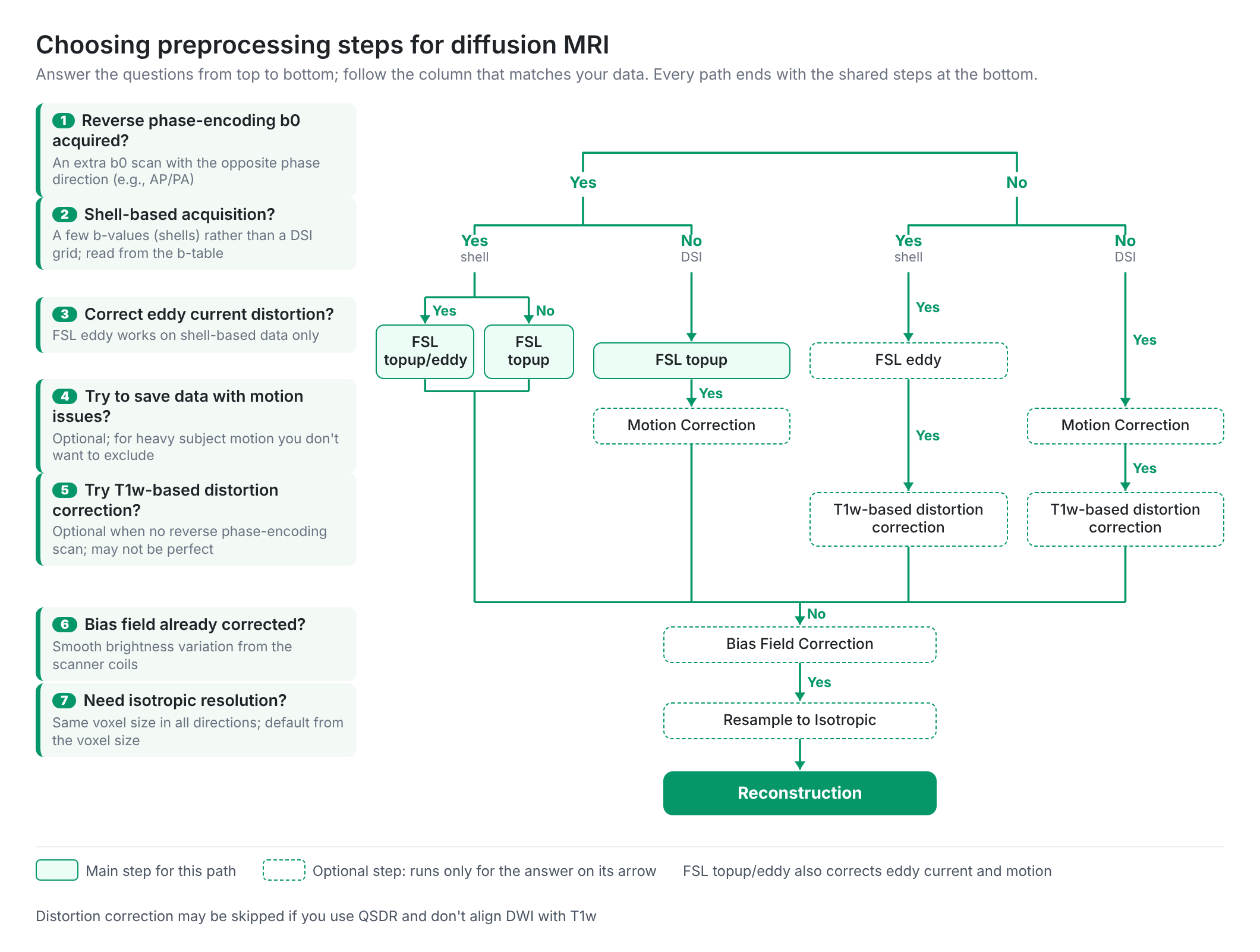
Answer the seven Yes/No questions from top to bottom. The first two (Reverse phase-encoding b0? and Shell-based acquisition?) select one of four columns. The remaining questions determine conditional processing: motion issues, T1w distortion correction, bias field already corrected, need isotropic resolution, and eddy current correction. The shell-based answer is preselected from the b-table, and isotropic resolution from voxel size. Confirm both against the source acquisition.
The highlighted column, followed by applicable shared operations at the bottom, defines the path. Dashed steps are optional. Choosing Yes for a reverse-phase image or T1w correction prompts for the corresponding image; canceling that picker restores No. Run Preprocessing applies highlighted steps in order and skips those recognized as already completed in the SRC methods report; processing stops if an operation fails or is canceled. Do not use the flow to apply every available correction by default. Inspect the results and preserve the raw SRC.
For exact question labels and instructions, see Reconstruct: Preprocessing page.
Susceptibility distortion
Echo-planar imaging is sensitive to magnetic susceptibility differences at air–tissue boundaries. The artifacts are strongest at the frontal tip, near the sinuses, and at the temporal base, where signals can be compressed, stretched, or lost. Susceptibility also distorts the entire head along the phase-encoding direction, typically by a few voxels.
Susceptibility distortion can cause a large mismatch between DWI and structural images, which affects targets aligned from the subject's structural images, for example T1w-based regions or surgical planning. In a group study where all data are spatially normalized to a template, it matters much less.
- With a reverse phase-encoding b0: the two opposite-phase images allow the distortion field to be estimated, for example with FSL topup. For shell-based data that also need eddy correction, both can be corrected together (FSL topup/eddy).
- Without a reverse phase-encoding scan: the b0 image can be warped to the subject’s T1w image. This is optional, and the correction may not be perfect.
Eddy current distortion
Eddy currents from the diffusion gradients shift, shear, or scale the diffusion-weighted images, differently for each gradient direction. Correct them only if the distortion is obvious, for example when edges in different DWI volumes do not line up. Many newer sequences reduce eddy currents considerably, for instance with bipolar diffusion encoding, so check whether it is needed for your sequence.
FSL eddy requires shell-based acquisitions; grid (DSI) sampling relies on eddy-current compensation at acquisition instead (see How to acquire dMRI).
Motion
Eddy correction also corrects motion. Alternatively, motion and eddy distortion can be detected from the correlation between neighboring DWI volumes, and the few outlier volumes can be dropped. Instead of correcting motion-corrupted data, dropping outliers is often a simpler solution. If the subject moved a lot and the reconstruction is corrupted, correction may rescue the data, but acquiring new data is often the best solution.
Bias field
The bias field is a smooth brightness variation across the image caused by the receiver coils. Correcting it evens out the signal and is recommended unless the data were already corrected.
Isotropic resolution
This is perhaps the most important step: tractography needs an isotropic voxel size and fails when the resolution differs greatly between directions. If the voxels are not isotropic, resample the data to an isotropic resolution.
Denoising
Denoising is generally not recommended for GQI and QSDR, which are relatively robust to noise. Other reconstruction methods are more sensitive to noise and may need it more. Most denoising methods, from simple smoothing to more advanced approaches, mix signals between neighboring voxels, so spatial information can change in the process. There are still cases where denoising is needed to save the data: if it lowers the noise enough to retain usable DWI signals, it can turn unusable data into usable data.
In DSI Studio
The reconstruction window follows this decision flow on its Preprocessing page. See Reconstruct: preprocessing for step-by-step usage.